Concinnity
Built at Built with Claude: Life Sciences · Jul 7, 2026 · Remote
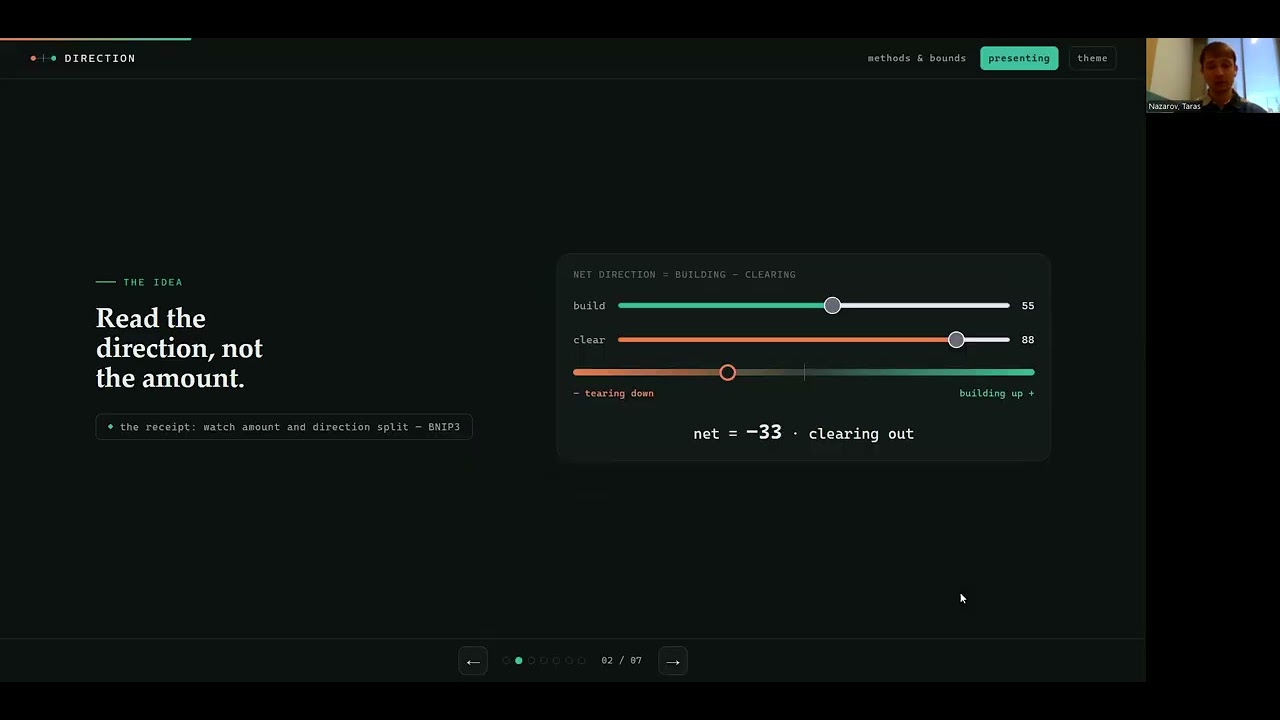
We built a directional readout of organelle dynamics. Standard analysis measures how much of an organelle is present - it can't separate a cell building an organelle up from one blocking its clearance, and the clearance genes (selective-autophagy receptors like BNIP3) aren't in conventional organelle signatures. We score the building and clearing programs separately and subtract: one signed number whose sign is the biology. What we found: reading direction, not amount, predicts mitochondrial vulnerability in cancer. Across 1,066 DepMap cell lines, higher mito-biogenesis direction means stronger genetic dependency on that machinery (ρ=−0.35, p=1.7×10⁻³²) - and it's specific (the same test on ribosomes is null). From expression alone it also ranks drug response: the clinical Complex-I inhibitor IACS-010759 lands in the top 3% of 1,514 drugs, and MitoQ ranks #1. Direction beats amount on the vulnerability endpoint (AUROC 0.67 vs 0.61). Why it matters: OXPHOS-targeting cancer drugs keep stalling on patient selection - no one can tell in advance which tumors depend on their mitochondria. This reads exactly that, from data already collected. Honest bounds: effect sizes are modest, the cancer results are in cell lines, and our one patient-survival test (TCGA-KIRC, 510-tumor cohort) is a clean null at power - reported. All public data.