Ani007Sciences
Built at Built with Claude: Life Sciences · Jul 7, 2026 · Remote
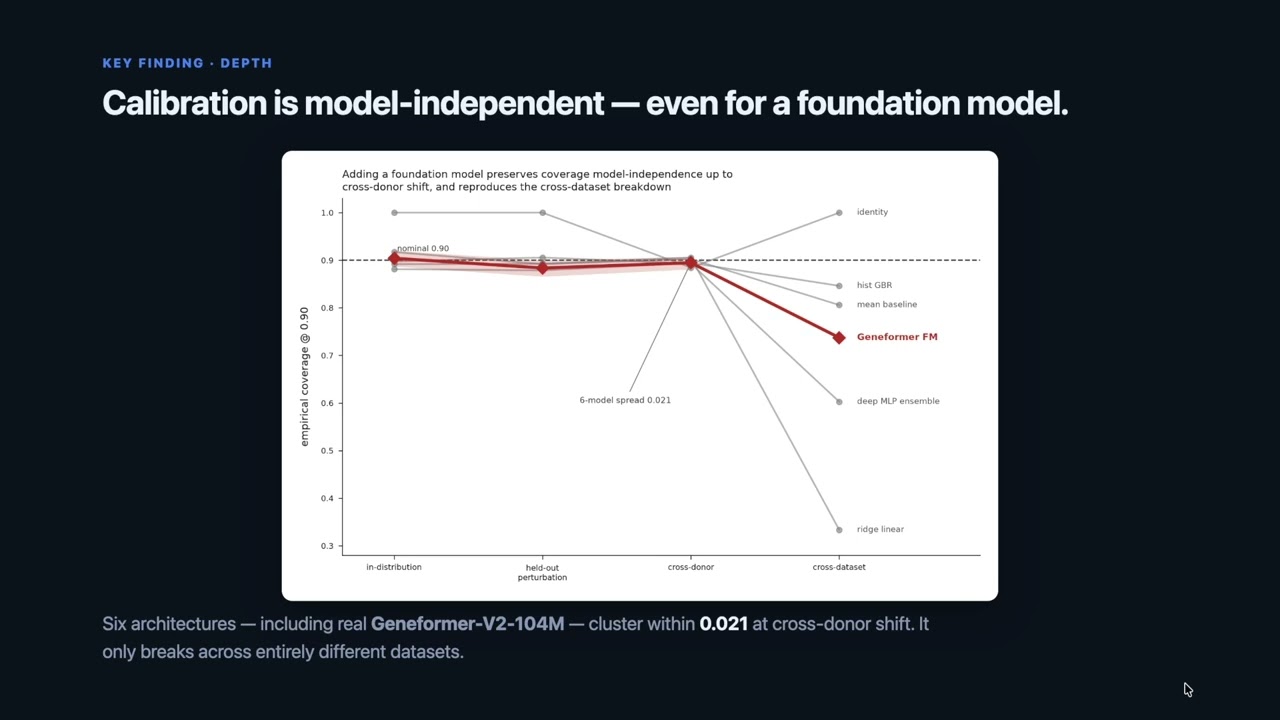
A pLDDT for perturbation biology. Foundation models don't reliably beat linear baselines at predicting perturbation effects (Ahlmann-Eltze, Huber & Anders, Nat Methods 2025) — so the real bottleneck isn't accuracy, it's knowing WHICH prediction to trust before spending scarce wet-lab budget. TrustLayer wraps any perturbation-effect predictor with split-conformal calibration and a default-deny commit gate that outputs GO / WITHHOLD / ABSTAIN. We pre-registered and hashed the protocol BEFORE running it, then let it falsify our own exploratory headline. Findings: (1) coverage under cross-donor shift is mild (0.88-0.91 @ nominal 0.90), not the "severe collapse" our first pass claimed; (2) calibration is model-independent across 6 architectures including a real Geneformer-V2-104M foundation model (cross-donor coverage spread 0.021), and breaks only under cross-dataset shift; (3) the trust gap does NOT transport label-free across 9 independent public datasets (Spearman +0.32, n.s.) — but a 5-20% labeled anchor recalibrates it; (4) trust-gated target selection avoids ~$160k-$1M in wasted arrayed-CRISPR screens at a 200-target budget. On real T1D targets the gate calls CD226→GO, RASGRP1→ABSTAIN, PRKCQ→WITHHOLD. It ships: pip install trustlayer-perturb, 27/27 passing tests + a gate ablation (all 5 conditions load-bearing), donor-clustered bootstrap CIs on every number, and an interactive, hash-verifiable Honesty Ledger documenting Claude catching and retracting its own bug. Live demos: https://ani007lahiri.github.io/trustlayer-perturb/
