G-perturb
Built at Built with Claude: Life Sciences · Jul 7, 2026 · Remote
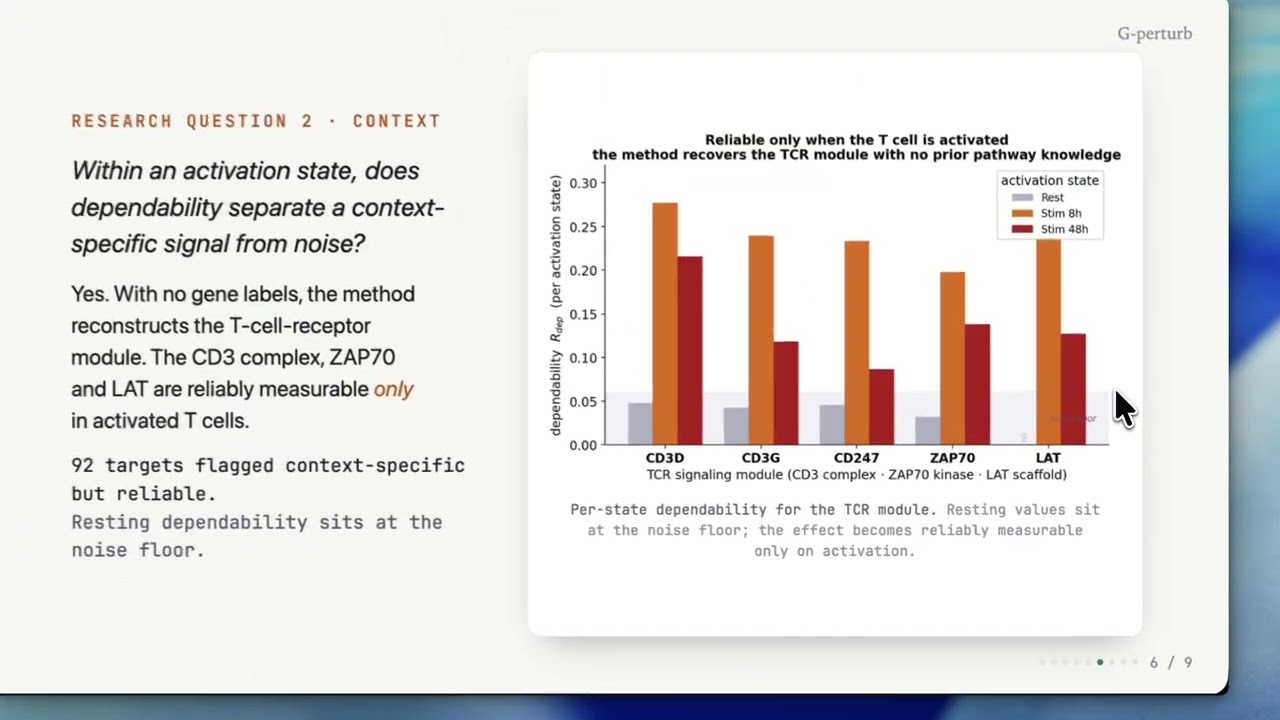
G-perturb re-ranks drug targets from a genome-scale CD4+ T-cell Perturb-seq screen by whether each effect is dependable, not just by how large it is. A large transcriptional effect seen in a single guide or a single donor can be measurement noise, and each false lead costs a validation experiment. I treat every perturbation effect as a measurement in a crossed guide-by-donor-by-condition design and use generalizability theory, a framework from psychometrics, to give each target one dependability coefficient, then rank by effect size weighted by dependability. On the released 44.6 GB pseudobulk this reorders the shortlist: 50 of the top 100 targets by raw effect drop out of the top 100 by dependability. Read within activation states, the coefficient reconstructs the T-cell-receptor module (CD3 complex, ZAP70, LAT) as reliable only in activated cells, with no gene labels supplied. A design study shows the screen is limited by the number of guides, not donors. Every methodological decision was recorded and adversarially red-teamed by a competing model before any result was seen; the analysis regenerates end to end, and the manuscript is submitted to bioRxiv.