Reelin' from Alzheimer's Disease
Built at Built with Claude: Life Sciences · Jul 7, 2026 · Remote
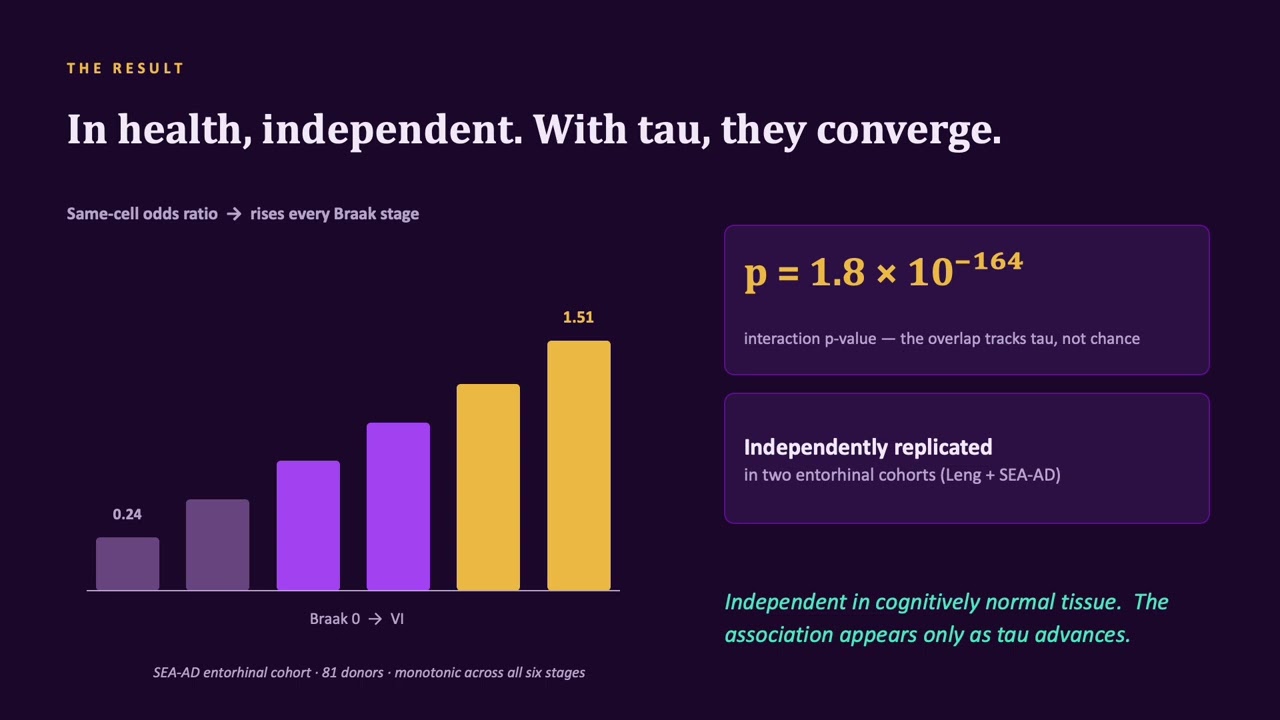
Which neurons die first in Alzheimer's, and why those? I investigated whether two markers of the selectively vulnerable entorhinal-cortex neurons that seed tau pathology — Reelin (RELN) and the transcription factor RORB — occupy the same individual cells, and whether that co-occupancy tracks disease. Using Claude Science, I built the analysis end to end: harmonizing ten public human datasets across single-cell, spatial (MERFISH), and bulk transcriptomics (>4M cells) and fitting depth-controlled, donor-clustered models that test the two genes as a pair. The findings show that RELN⁺/RORB⁺ detection is independent in healthy tissue but converges with advancing tau stage — a monotonic six-stage dose-response, independently replicated in an 81-donor cohort with 10× higher depth (exactly the condition that would inflate a detection artifact — which it doesn't), confirmed in intact tissue by MERFISH, absent in other tauopathies, and amplified by APOE-ε4 dose. Regulatory-network, ChIP-seq, and structural analyses rule out a direct molecular link, establishing co-vulnerability rather than partnership. This sharpens the map of AD's earliest-lost neurons and ties it to APOE4 — the field's strongest genetic risk factor — via Reelin–ApoE receptor competition: a hypothesis-generating finding, with the decisive next experiments specified, that others can build on directly.
