Coco and the Cancer-naughts
Built at Built with Claude: Life Sciences · Jul 7, 2026 · Remote
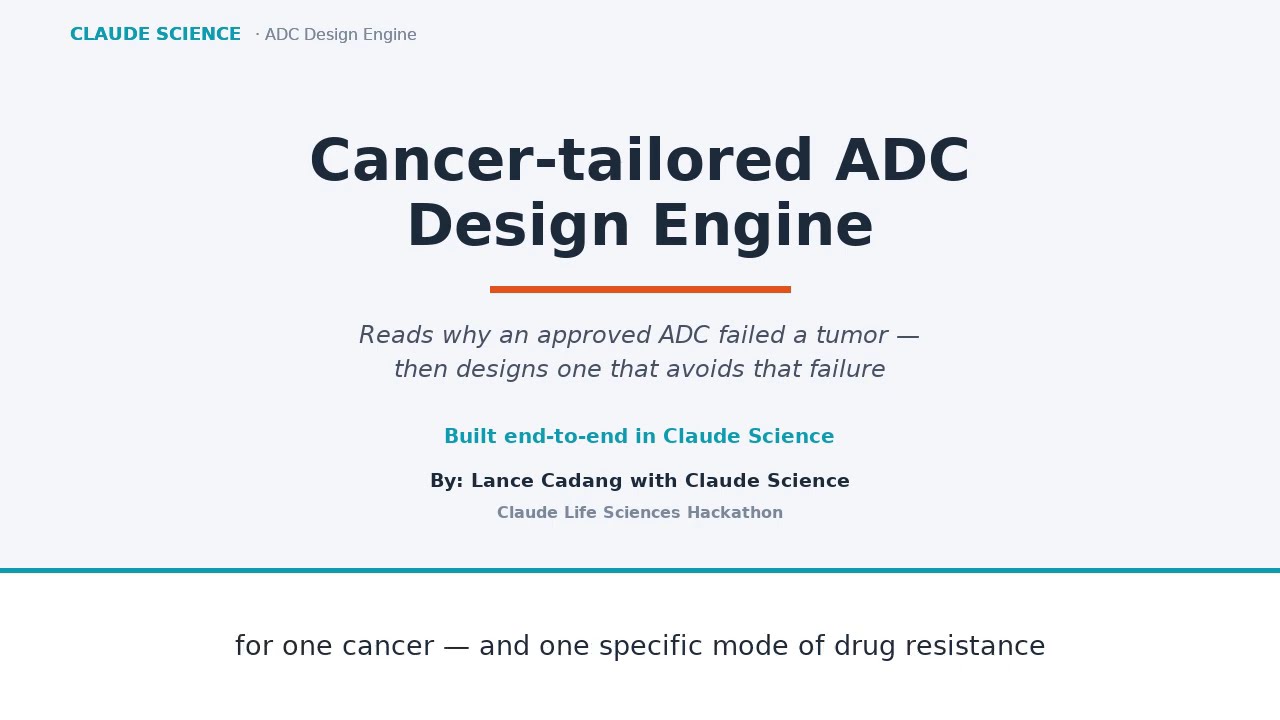
The bottom line: An AI agent that reads why an approved cancer drug failed a tumor — then designs a new antibody–drug conjugate (ADC) engineered to dodge that exact resistance. Built end-to-end in Claude Science, grounded entirely in live data. What I built: One agent, five modules, each querying live databases — not memorized answers. Test case: TNBC that progressed on Dato-DXd (an approved ADC). A · Resistance (ChEMBL, FDA, PubMed) → B · Target (Open Targets, GTEx, HPA) → C · Payload (PubChem, ChEMBL) → D · Structure (PDB, AlphaFold, Boltz-2 via NVIDIA BioNeMo) → E · Landscape (ClinicalTrials, bioRxiv) Output: a fully-sourced dossier where every ID traces back to the query that produced it. What I found The failure is payload-class, not the molecule. Dato-DXd's TOP1-inhibitor warhead is cross-resisted by every TOP1i ADC — so the fix is a new mechanism, not a new antibody. A resistance-orthogonal design: LIV-1 antigen (TROP2, the failed target, drops to rank 7) + MMAF payload (dodges both the TOP1i and the efflux resistance) + non-cleavable linker, DAR4. Structure overturned the answer. Boltz-2 folded all three candidate targets and inverted the expression ranking: the top expression target (LIV-1) is the weakest structure (pLDDT 33); B7-H3 is the strongest (91). The real output is a two-axis map, not a single pick. Why it matters ADC resistance is a growing clinical reality with no systematic way to design the next drug against it. This engine makes resistance the design input, and — critically — lets one tool (structure) overturn what another (expression) would have asserted with false confidence. Reproducible, fully traceable, and it generalizes to any (indication, failed-drug) pair. In-silico hypothesis, not a validated asset; key risks (LIV-1 foldability, payload tolerability) stated explicitly.
