Natioan taiwan university hospital Cancer center
Built at Built with Claude: Life Sciences · Jul 7, 2026 · Remote
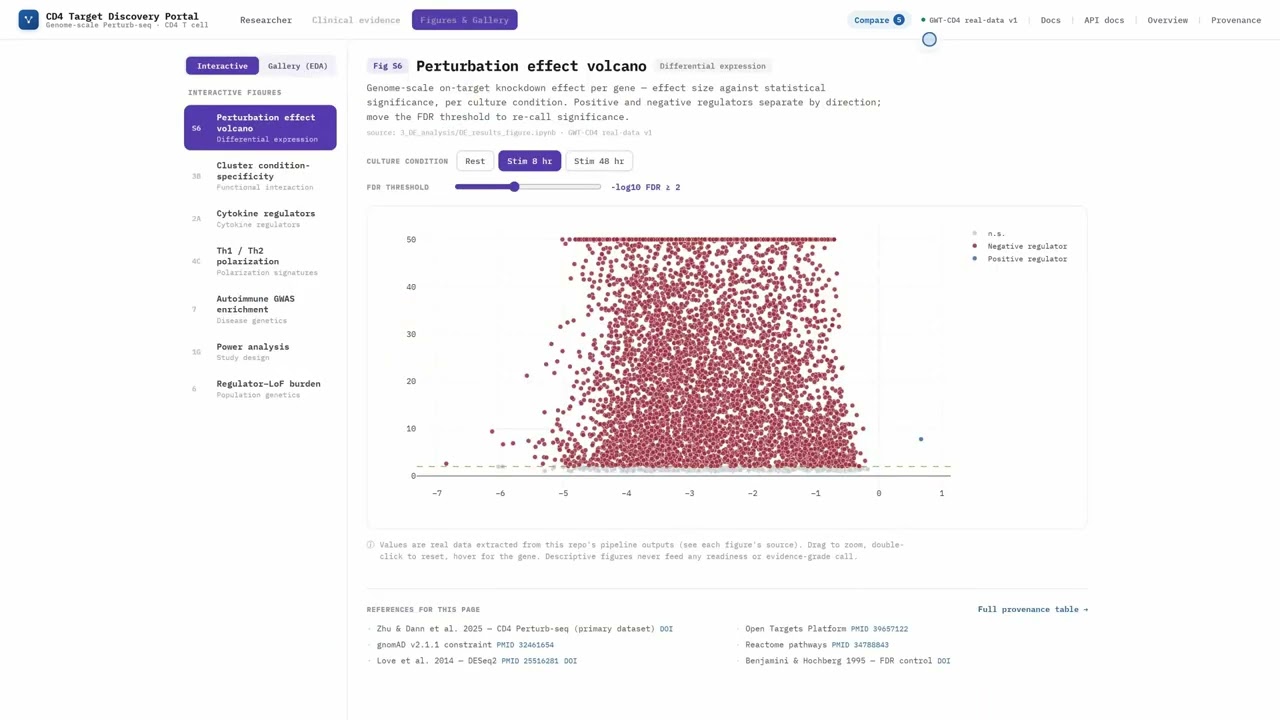
What we built: A genome-scale CRISPRi Perturb-seq screen in primary human CD4⁺ T cells turned into a working target-discovery system — not just an analysis. A FastAPI scoring engine for researcher and physician converts raw differential-expression data into 39-field "target cards" (effect size, knockdown confidence, cross-donor robustness, druggability, safety liability, human genetic support), feeding a readiness engine that outputs one of four calls (advance/validate/watchlist/deprioritize) per gene, served through a React portal and a live CSV-upload path so anyone can score their own screen with the same engine. What we found: Two independently-motivated ranking paths — a portal-readiness funnel (302 advance-ready targets) and a publication-decision funnel (39 context-specific, druggable targets) — converge on a 5-gene "Core-5" intersection with an independent 15-gene primary-outcome shortlist. Those calls hold up against data we never used to build them: 55/55 Open Targets disease associations, STRING-confirmed interactors at ≥700 confidence, and replication in an independent public CRISPRa HIV screen (GEO GSE318876). Why it matters: The hard part of a screen like this isn't generating hits, it's not fooling yourself about which ones are real. We enforced that architecturally: only 4 scores and 7 red-flags can move a target's call, every safety/genetic overlay is descriptive-only and regression-locked so it can never silently override that call, and missing data is shown as "unknown," never imputed as zero — known golden-standard genes (ZAP70 correctly grade-4, MED12 correctly flagged as broad-effect). That's what turns one expensive screen into a reusable, falsifiable pipeline instead of a one-time hit list.