Mightytreefolk
Built at Built with Claude: Life Sciences · Jul 7, 2026 · Remote
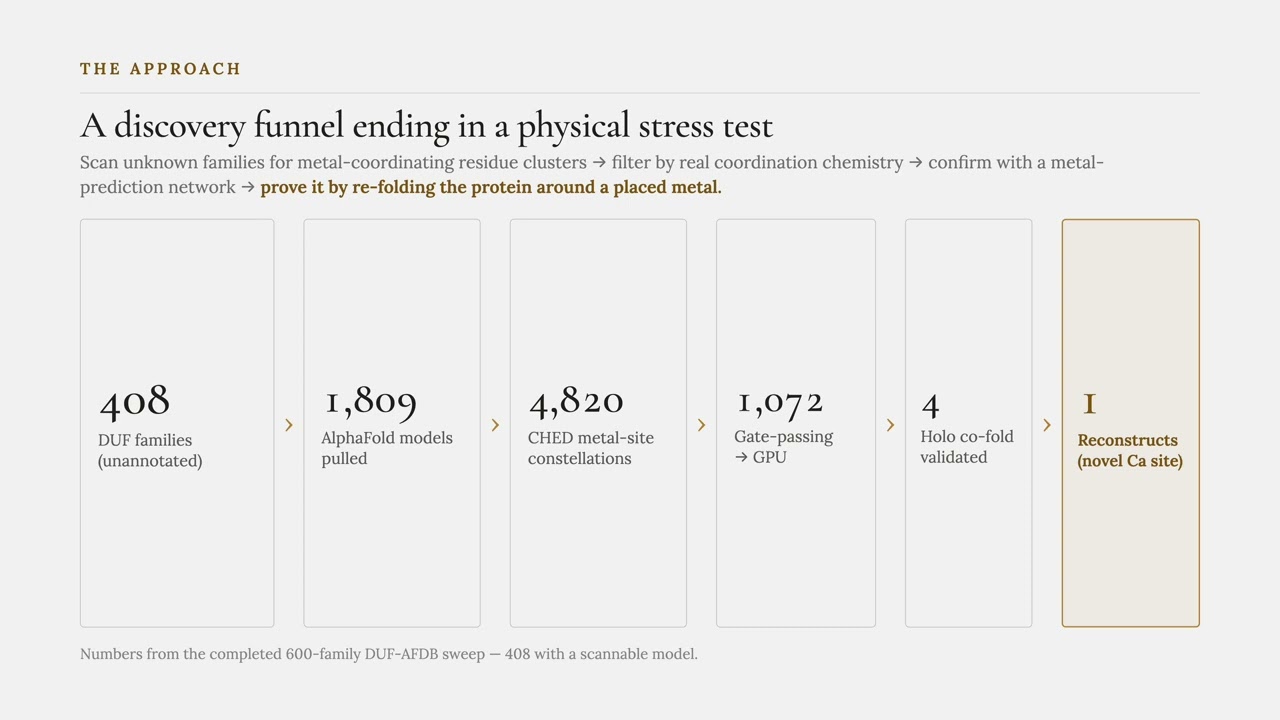
Why it matters. It is frequently cited that roughly a third to half of all proteins bind a metal, and the metal is frequently what makes an enzyme an enzyme, the catalytic center itself, and often a small molecule target (hemoglobin's iron is why carbon monoxide is lethal). Yet thousands of protein families remain completely uncharacterized. Homology-based annotation is blind to these orphans by construction. MetalloHunter demonstrates that you can take genuinely dark proteins and, without any homolog, identify which ones carry metal sites and assign them a known functional character, here, dark DUFs that display the coordination chemistry of known Ca²⁺-dependent hydrolases. Rigor was checked against a blinded 76-structure control package (metal-prior sensitivity 0.78 at specificity 0.92; a separate 29-structure benchmark reached 0.74 at 100% specificity), with the only false positives being the trypsin catalytic-triad decoy we planted deliberately. What we built. MetalloHunter is a four-stage discovery pipeline that scans AlphaFold structures of functionally uncharacterized protein families (Pfam "Domains of Unknown Function," DUFs) for metal-binding sites, classifies their coordination geometry and chemistry, and then physically stress-tests the top candidates on a GPU, placing the predicted metal, co-folding the holo structure with Chai-1, and measuring whether the coordination sphere actually reconstructs. The premise: a cluster of Cys/His/Glu/Asp residues in an apo model is only a hypothesis that a metal binds; a genuine site locks the metal into place when physics acts on it, while an adventitious cluster falls apart. That contrast is the validation signal. What we found. Sweeping 600 DUF families (408 with usable AlphaFold models, 1,809 proteins, 4,820 candidate sites), the pipeline surfaced 1,072 proteins with a metal-pocket signal and a tight top tier of 35 with the strongest dual signal (ideal-polyhedron geometry and a catalytic open-coordination vertex). Running these through AllMetal3D (metal-identity CNN) then Chai-1 (holo co-folding) produced physically validated hits, most notably two previously-uncharacterized proteins whose Ca²⁺ sites fully reconstruct (PF16480 and PF13961): both are carboxylate-anchored Ca²⁺ with an open coordination vertex, the coordination signature of the catalytic-Ca hydrolase class (phospholipase A₂, staphylococcal nuclease). We also confirmed the discriminator works in both directions, large multidomain proteins where the scan caught adventitious clusters correctly fail to reconstruct, and a Cys-rich family (PF25205) resolved to a structural zinc-ribbon fold rather than a catalytic site (verified not to be disulfides, the SG–SG distances are 3.8–4.1 Å, far above the 2.05 Å of a disulfide bond).
