Vivax
Built at Built with Opus 4.7: a Claude Code hackathon · Apr 21, 2026 · Remote
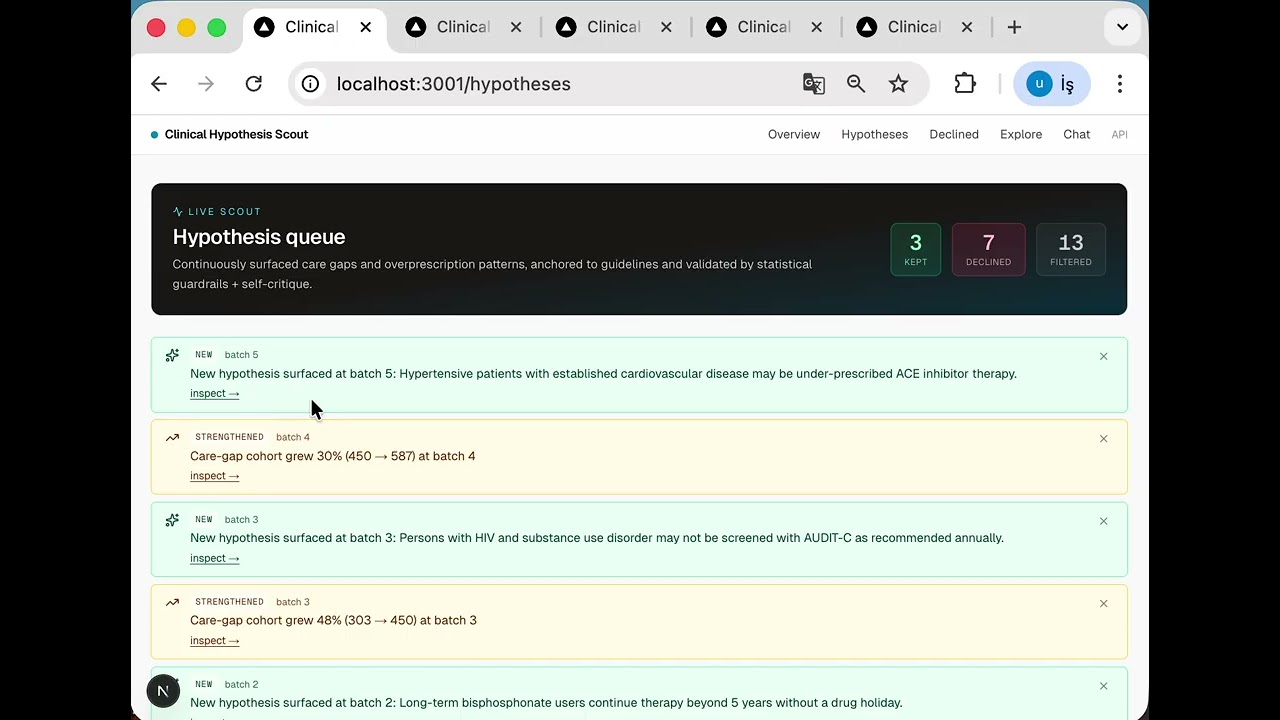
Clinical research leads spend weeks manually identifying care gaps and overprescription patterns in their patient population — querying EHRs, cross-referencing guidelines, validating statistically, packaging interventions. The Clinical Hypothesis Scout collapses this loop. A 7-phase Claude Opus 4.7 agent runs over a Neo4j graph of 21,582 patients, four medical ontologies (SNOMED, RxNorm, ATC, LOINC), and 458 recommendations extracted from 64 American clinical guidelines. Each surfaced hypothesis must pass three statistical guardrails, survive a self-critique that auto-declines synthetic-data artifacts, and arrive packaged with five live PubMed citations and an operational action plan covering intervention, owner, complexity, and dollar impact. What separates it from a hypothesis generator is the continuous-monitoring layer. The scout fingerprints each clinical pattern and emits NEW alerts when a pattern first appears, STRENGTHENED when its cohort grows by 20% or more across batches — in the demo dataset, a bisphosphonate-overprescription signal grew from 303 to 450 to 587 patients across three consecutive batches, the kind of consolidating pattern a research lead would want paged about. A Next.js dashboard exposes kept and declined queues with reasons, a cohort browser, a streaming NL query interface, and reproducible Cypher for every finding.