Kyōjo (共助)
Built at Built with Opus 4.7: a Claude Code hackathon · Apr 21, 2026 · Remote
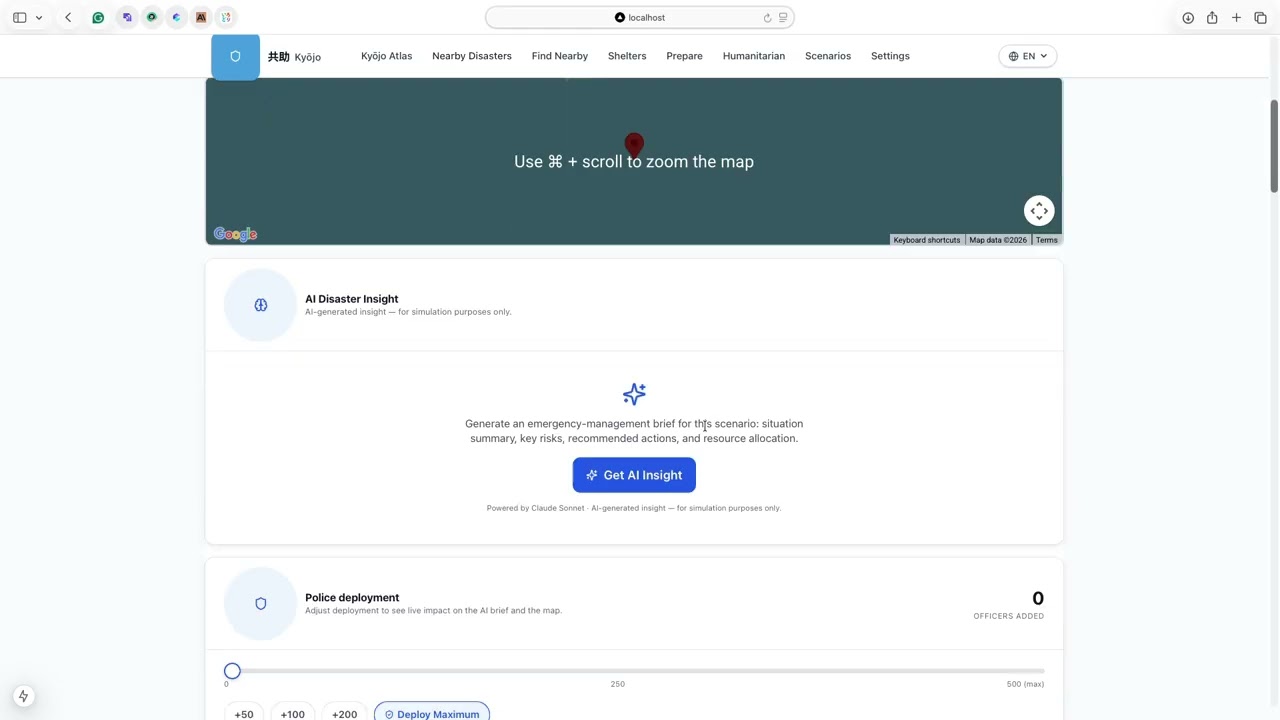
Kyōjo (共助 — "mutual aid") is a real-time humanitarian coordination platform for Japan's disaster response ecosystem. When a major earthquake or typhoon strikes, the gap between what people need and what reaches them is not a technology problem — it is a coordination problem. Emergency operators juggle disconnected systems. Foreign residents fall off the edge of Japanese-only alerts. Volunteer capacity sits idle while open needs go unfilled. Kyōjo solves this with three interlocking capabilities: 1. Interactive Japan Map — A Canvas 2D Mercator map centred on Japan shows aid-network flows between 8 cities across 8 regions. When a disaster scenario is selected (Nankai Trough, 2024 Noto, Typhoon, 2011 Tōhoku, or custom What-if), arc paths react in real time: gold flows break into dim disrupted lines and coloured emergency routes appear at the epicentre. 2. Claude Opus 4.7 Orchestrator — Dispatches 10 specialised subagents in 3 dependency-ordered waves to produce a complete, citation-verified operations packet in under 15 minutes: seismic situation report, damage assessment, real-time shelter discovery via Google Places, population vulnerability overlay, resource matching, and multilingual public alerts (JA + EN + dynamic third language via TTS). 3. Living Knowledge Base — 22-document preparedness corpus (Cabinet Office whitepapers, JMA guides, prefectural hazard plans) with BM25 retrieval, an AI chat interface, and enforced source citations — available in 14 languages. Built for NGOs, volunteer centres, and government responders. Fully accessible (WCAG 2.2 AA, JIS X 8341-3, reduced motion, audio alerts). Zero invented facts: the Verifier agent blocks packet release if any claim cannot be traced to a source.