Mesh
Built at Built with Opus 4.7: a Claude Code hackathon · Apr 21, 2026 · Remote
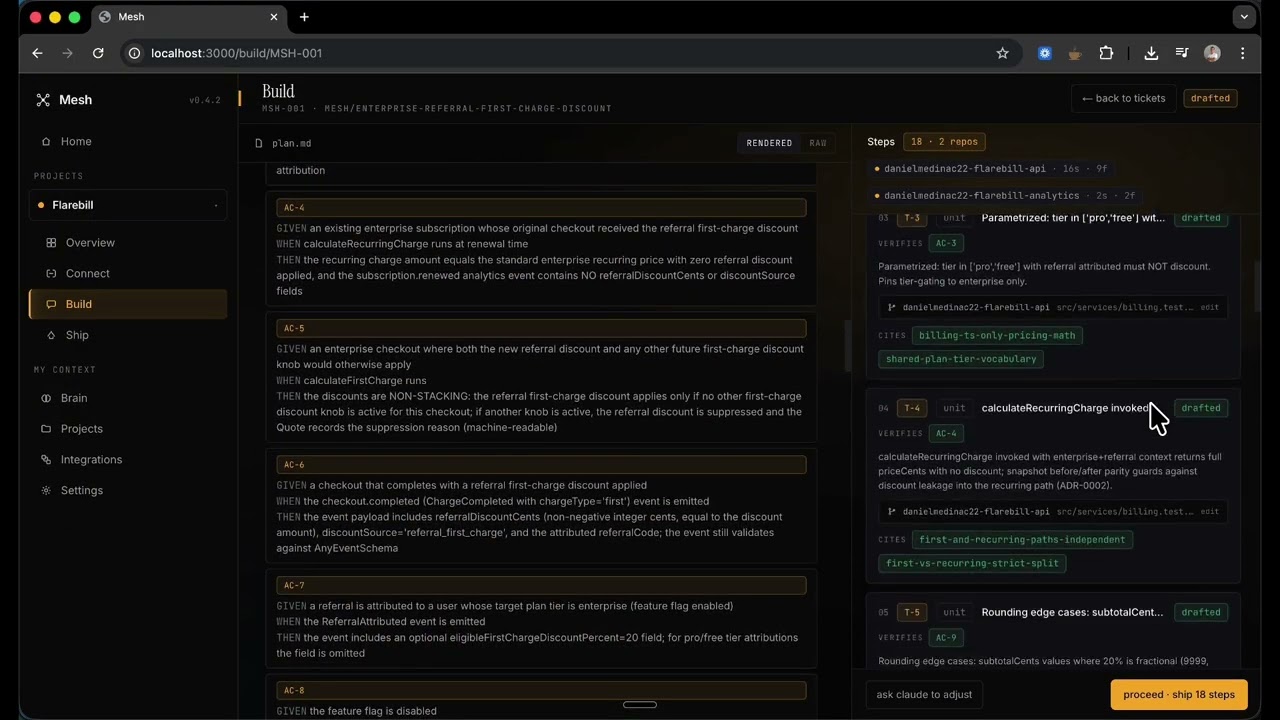
Mesh is the living layer over your N repositories. From a Jira ticket, a Linear issue, a Granola meeting transcript, or a Slack message from the CEO — to four synchronized pull requests on GitHub, in minutes. Not generated. Governed. Companies that ship product don't have one repo. They have 4, 12, 47 — web, api, analytics, content, design-system, mobile. When the CEO writes "20% off the first payment for enterprise referrals — and don't break renewals," that change touches four repos and four invariants at once. Today, only one engineer with years of context can land it without breaking MRR. They become the bottleneck. Mesh changes the contract: Anyone proposes. The system governs. Engineering reviews. Five surfaces, one continuous flow: Integrations: native pulls from Jira, Linear, Granola, and GitHub. A ticket lands in Mesh as structured intent — including the recording of the meeting where the decision was made. Authentication is real and minimal: gh CLI for GitHub, OAuth on the rest. No custom auth UIs, no cloud, no proprietary store. Brain: the cross-repo memory. Mesh ingests up to four full repos into a single 1M-token surface and distills them into invariants, decisions (ADRs), call graphs, and notes the user can edit. The Brain is what lets a non-technical proposal land somewhere coherent — it carries the org's history into every plan. Build: ticket → plan. A classifier decides the artifact type (PR, config, FAQ, comment), routes the right repos, suggests a feature branch, and drafts a step-by-step plan where every step cites a real invariant or ADR from the Brain. The human approves before a single line is written. Ship: real Git, real PRs. Branches are created, files written, commits pushed, and four real pull requests opened on GitHub via Octokit. The agent's tool calls are intercepted live by the skill pack — portable .claude/skills/*/SKILL.md files, 100% Claude Code compatible. When the agent tries to put pricing math in the frontend, single-source-pricing stops it. When it touches the recurring_charge path, no-renewal-impact restricts scope. The skill pack is the synthetic staff engineer of the org. Skills editor + AI improver: the governance is editable in the browser, and Mesh's own sub-agent suggests improvements to your existing skills as your codebase evolves. Why Claude Opus 4.7 is non-substitutable: 1M context: the Brain is not “a repo loaded” — it's an organization loaded. Four full repos in one window is the difference between a coherent plan and one that breaks three things. Extended thinking, visible: the thinking panel is the protagonist UI. The audience watches the model reason against the skill pack and self-correct in real time. That's what turns governance into a product instead of magic. Long agentic loops: Ship runs for minutes across 4 repos with inline validation on every tool call. Haiku or GPT-4o lose the thread before the final PR. Swap Opus 4.7 for any other model and Mesh stops working. The model isn't a dependency — it's part of the architecture. The demo opens with a pull request that was merged 4 minutes ago. Author: ceo@acme.com . Twelve files changed across four repos. Three skill checks green. The CEO's Slack is timestamped 9:47am; the merge is 9:51am. Not a single line written by an engineer. That's the workflow Mesh proposes for what's next. Built on Claude Opus 4.7. Powered by the Claude Agent SDK. Skills portable to any Claude Code user — your governance grows with your codebase.