Mobius
Built at Built with Opus 4.7: a Claude Code hackathon · Apr 21, 2026 · Remote
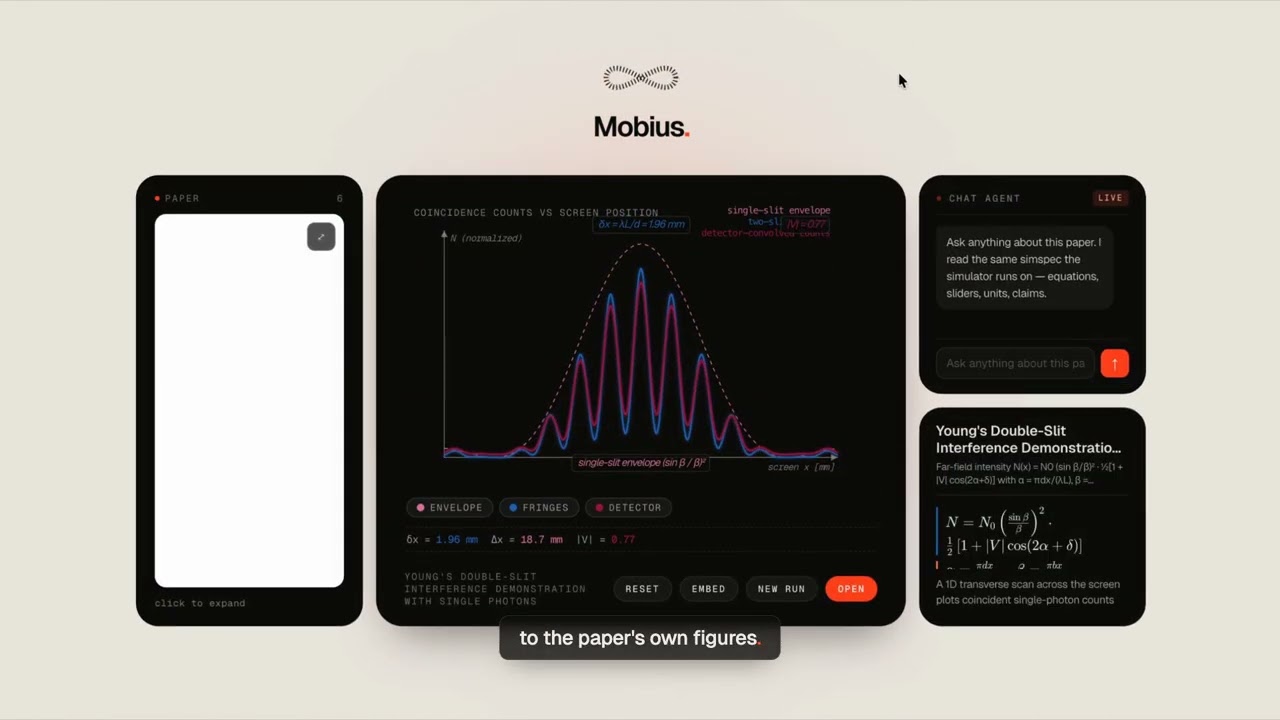
You drop a physics paper as a PDF. You get back an interactive simulator that runs the actual physics from the paper, validated against the paper's own figures. The visual style borrows from Bartosz Ciechanowski's interactive explainers. There's one Opus 4.7 model in the middle, acting as a conductor. It drives nine specialist skills along an explicit DAG over seven phases. In Phase A, three parsers run in parallel: paper-parser, physics-interpreter, claim-extractor. They fan into a typed SimSpec. From there the pipeline fans back out into Python primitive generation, sandboxed execution inside Anthropic's Managed Agents Python runtime (numpy, scipy, sympy), and an interactive scene wired to those primitives over SSE. When you move a slider in the scene, the solver re-runs in the sandbox. It's not animation, it's the real solution being recomputed. Every output goes through a parallel science-integrity critic that runs eight orthogonal checks. Pre-render: units, CFL stability, conservation residual, claim-match, eligibility. Post-render: perceptual figure-diff using Opus 4.7 vision, narration-bijection, multimodal triangulation. The problem I'm trying to solve: physics papers ship as static PDFs, but the equations they describe are dynamic interactive systems. Reproducing a paper's figures normally takes a domain expert, a numerical stack, and a couple of weeks. Mobius makes the paper *be* the simulator. About 25 minutes per run, on any PDF, with the actual physics, perceptually checked against the source.