Praxis
Built at Built with Opus 4.7: a Claude Code hackathon · Apr 21, 2026 · Remote
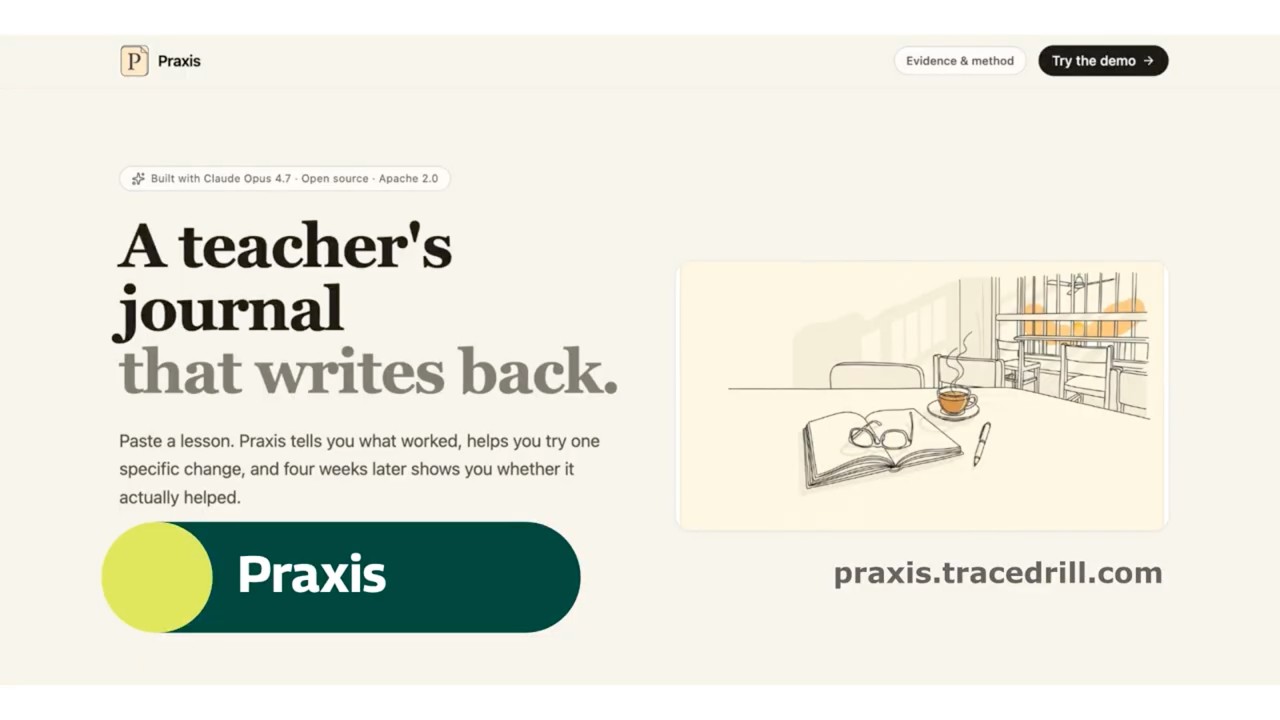
Praxis is a teacher's journal that writes back. Every Sunday night, every teacher in the world asks the same question. Did this week of teaching make me better, or worse? She has no instrument to answer it. Doctors got imaging. Lawyers got case law. Pilots got instruments. Teachers have had only each other — and a profession that's haemorrhaging the people who do it best. In 2026, OECD published the Teacher Knowledge Survey: the first international measurement of teacher pedagogical knowledge, validated across eight countries and twenty thousand teachers, normalised against a global benchmark. Seventeen scales spanning instruction, learning, assessment, self-efficacy, well-being, and opportunity to learn. It is the closest thing teaching has ever had to an instrument. And until Praxis, no productized tool had ever turned it into something a teacher could actually use. Praxis is that tool. The teacher writes a note in her journal — about a student, a lesson, or how the week felt. Six specialist Claude Opus 4.7 agents work in parallel: — Memory searches her year of teaching for patterns — Mirror scores the practice on five OECD classroom-observable scales, with line-level evidence — and abstains when the evidence is thin, instead of fabricating — Research fans out across six free databases (ERIC, Semantic Scholar, OpenAlex, PubMed, Crossref, What Works Clearinghouse) and live-verifies every citation through Crossref DOI lookup — Experiment turns one suggested change into a four-week test on her own class, with a published study attached — Attention flags the students who've gone quiet — Safeguarding watches for child-welfare signals A seventh agent — the Coach — orchestrates the team, pushes back with evidence when the teacher is about to make a mistake, and replies in one human voice. Every claim cites a paper. Every score either lands on a student moment, or abstains. Every student name is hashed to an HMAC token on her device before anything reaches the cloud. Raw PII never leaves the phone. That is structural, not a disclaimer — there is no server-side fallback. The stakes are not abstract. Thirty-seven percent of OECD teachers already use AI in their work. Their default tool — generic ChatGPT — has been measured to drop student exam scores by seventeen percent (Bastani, Türkiye RCT) and exact recall to twelve percent versus eighty-nine percent in brain-only groups (Kosmyna, MIT). Teachers and students are adopting AI faster than education systems can respond. Praxis is what the response should look like: grounded in validated instruments, evidence-cited, on-device-private, and honest enough to say "I don't have enough evidence to score this." Praxis doesn't tell a teacher whether she's a good teacher. It tells her whether the one change she made this week actually worked — on her own class, in her own classroom, against her own baseline. That has never existed before.