CAIQ
Built at Built with Opus 4.7: a Claude Code hackathon · Apr 21, 2026 · Remote
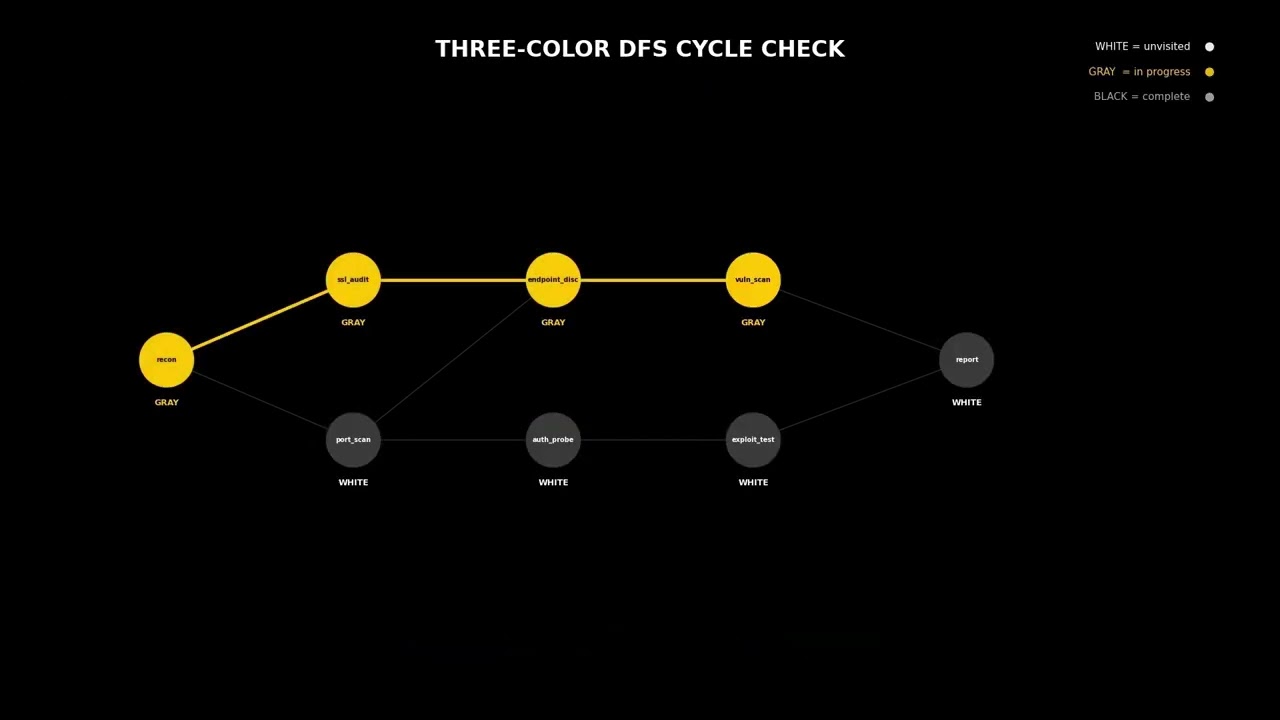
The $13 Billion AI orchestration market is currently trapped in "Probability Hell." Incumbent frameworks like LangChain and AutoGen rely on open-ended ReAct loops. At enterprise scale, a single 5% hallucination rate creates a cascading execution decay, making massive multi-agent swarms mathematically unsafe for mission-critical production. SWARM-FORGE is the Defense-Grade Operating System for Agents. I replaced probabilistic guessing with Topological Determinism and Zero-Trust execution. The Architecture: Zero-Shot DAG Compilation: You feed Swarm-Forge a raw enterprise objective. Instead of blindly executing, Opus 4.7 acts as a Meta-Orchestrator, autonomously compiling the problem into an immutable Directed Acyclic Graph (DAG) infrastructure. Mathematical Proofs: Before a single agent spawns, Kahn's Algorithm and a Three-Color DFS validate the execution order. Cycles and infinite loops are physically rejected at plan time. AgentGuard AST Firewall: I engineered a custom 4-stage zero-trust middleware. If an agent hallucinates a rogue command, my ActionFirewallVisitor drops the capability at the Abstract Syntax Tree (AST) level—before the code ever reaches the interpreter. Byzantine State Lock: A node only passes if it achieves a Byzantine consensus threshold verified by a fail-closed Sonnet 4.5 Reward Judge, ensuring 0.0% unauthorized execution in my benchmark suite. Swarm-Forge doesn't just route agents; it provides the deterministic, mathematically secure rails required to safely scale the $13 Billion orchestration market.