AgentGlass
Built at AIE Code Summit 2026 Hackathon · Nov 7, 2026 · San Francisco, CA
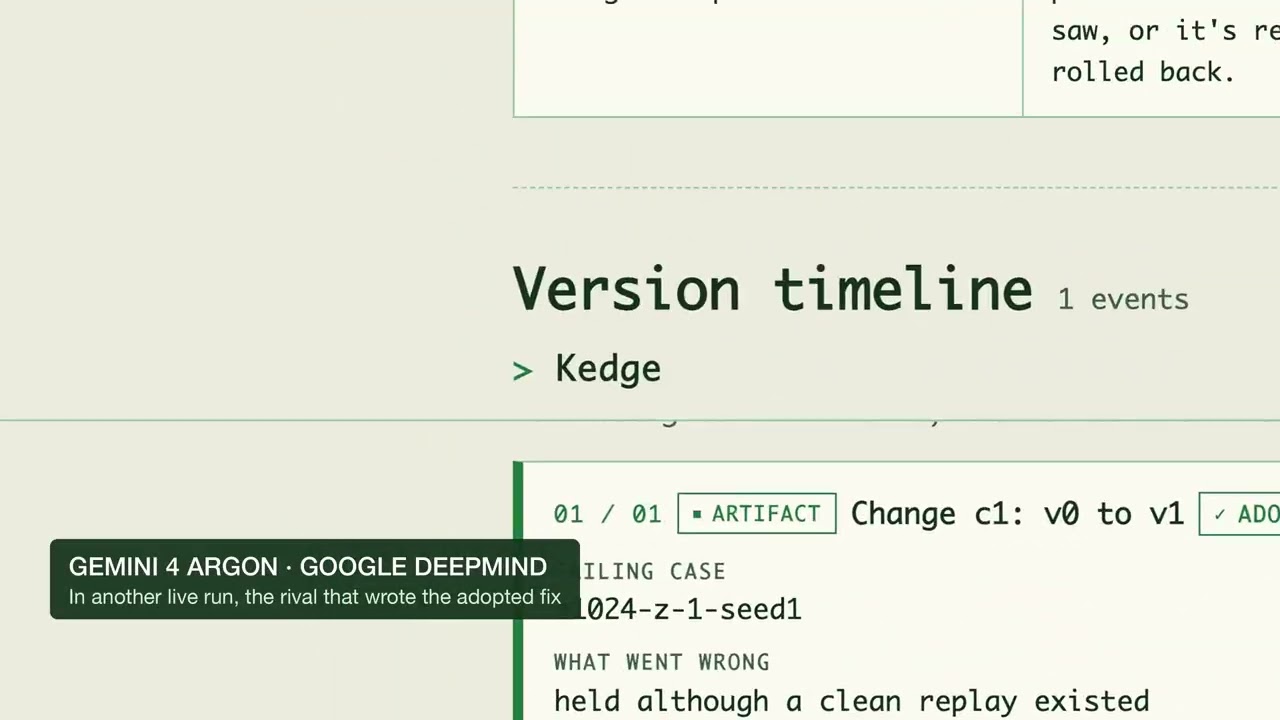
Kedge. Live demo: https://kedge-demo-steel.vercel.app/improve https://kedge-demo-steel.vercel.app/ A coding system that gets better at porting legacy software. Each failure becomes a versioned change, and the system keeps only what held-out cases confirm. The problem. An integration maintainer retiring an old message queue (beanstalkd) has to decide, at the cutover, which saved jobs to import into the replacement. They can't see the old queue's own ledger; all they have is what a restarted copy of its saved log reports. Getting it wrong is silent: on one recorded cutover, a replacement that passed its own tests lost 17 accepted jobs and brought 10 deleted jobs back. Coding models can write a port quickly, but they can't yet get better from their own failures without fooling themselves: a change that fixes the case in front of it can quietly break the cases it was never tested on. What I built. Kedge's loop turns each failure into a change it has to prove on held-out work. The task: write the cutover import decision (import from a replay, ask for a replay at a raised limit, or hold for a person). A judge scores every answer against the ledger, which the port never sees. Every case is a recording of the real beanstalkd: 12 development, 6 promotion and 7 audit cases, fixed before any run. Meta's Muse Spark triages a failure and Muse Wonder writes one versioned change; Gemini 4 Argon is a rival implementer. Each candidate runs in a sandbox with no network. The gate adopts only if nothing that passed now fails and promotion strictly improves; audit is checked last, and any audit loss means reject. A separate Muse Wonder context writes new held-out cases from the protocol text alone, each recorded live on the real beanstalkd; a failure on a new case rolls the version back. A version is promoted only with a one-use approval code bound to its digest. Results, from the live runs. Run 1: four Spark workers wrote v0 at 6/12 development, 3/6 promotion and 4/8 audit; one adopted change gave v1 at 12/12, 6/6 and 8/8, and a person approved v1. Run 2: Argon and four Spark workers each wrote a first version (all 6/12); the gate adopted Argon's fix: promotion 3/6 → 6/6, then 12/12, 6/6 and 9/9 with two new challenger cases.
