Vyrelith
Built at The Future of Agentic AI in Healthcare - Abridge x Anthropic x Lightspeed · Jul 18, 2026 · San Francisco, CA
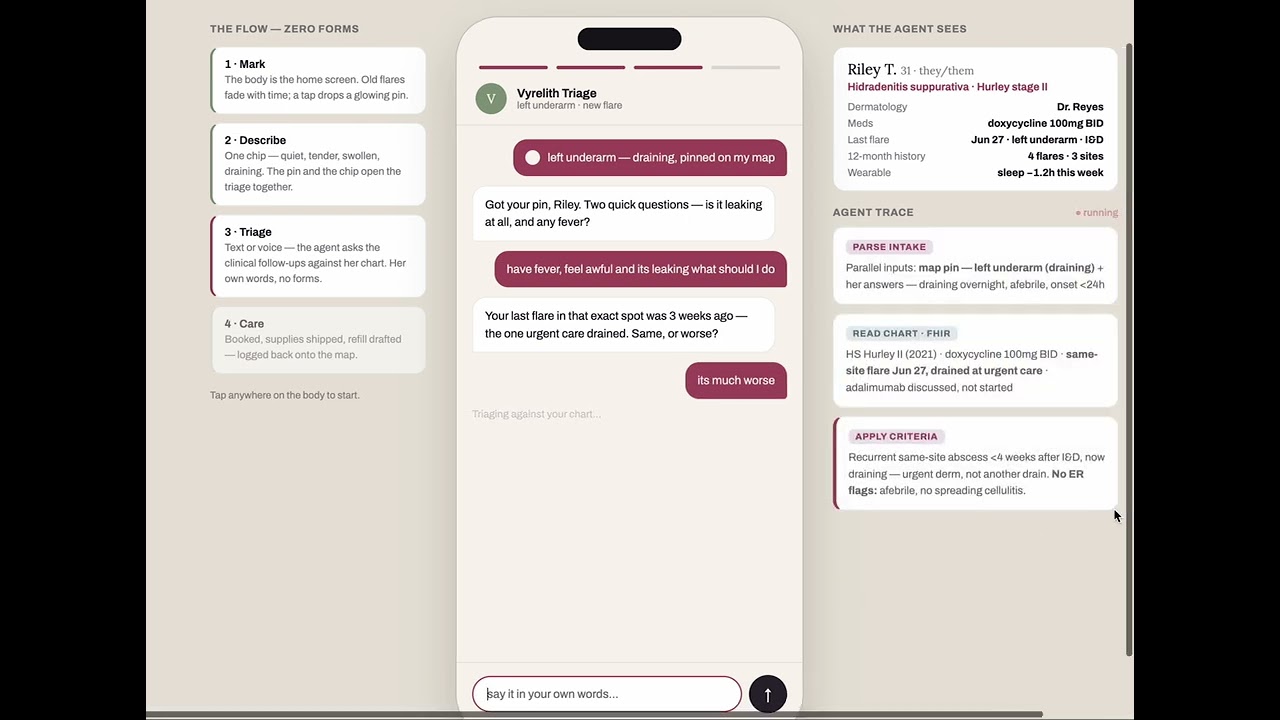
Vyrelith is a connected triage and record-keeping system for people living with hidradenitis suppurativa (HS) — a chronic auto-inflammatory disease with an average diagnostic delay of 7–10 years, where most of the disease's story happens between clinic visits and never makes it into the chart. I built this based on my own experiences having Hidradenitis and ending up in the ER many times - trips that could be avoided. How it works. A patient texts the app the way they'd text a friend — typos, worry, and all. Claude (Opus, streaming) reads their message against their full FHIR record — conditions, medications, labs, the last clinic note, and the word-for-word visit transcript — plus every prior check-in, and does four things at once: replies in warm, plain language (built on HS-community language rules: "flares" and "tunnels," never "boils" or "contagious"), updates a structured symptom record, flags flares, oddities, and anomalies (an undocumented site, a silently stopped medication, a missed follow-up window), and notifies the right member of the care team directly — the patient is never told "call your doctor" as the plan; the system does the reaching out and says so. The clinician sees deltas, not transcripts. The console leads with what changed since the last update: before→after rows with the patient's verbatim words attached to each change, new and cleared flags, escalation shifts, and a prominent anomalies card — with a separate tab showing the agent's full reasoning trace (parse → chart → signals → criteria → route → safety), each step citing chart facts and patient quotes. The EHR itself is never mutated; check-ins live in an app-side record, provably leaving the FHIR source untouched. The data. Ships with 10 fully synthetic HS patients built for the demo — diverse in stage (Hurley I–III), scenario (ED abscess, biologic initiation, postpartum flare, HS+Crohn's overlap), and voice (minimizers, anxious question-askers, monosyllabic teens) — authored, adversarially audited, and fixed by a multi-agent pipeline, in the same FHIR R4 format as the hackathon's ambient-encounter dataset.
