Mighty Morphing
Built at National Security Hackathon (by Army xTech) · May 2, 2026 · San Francisco, CA
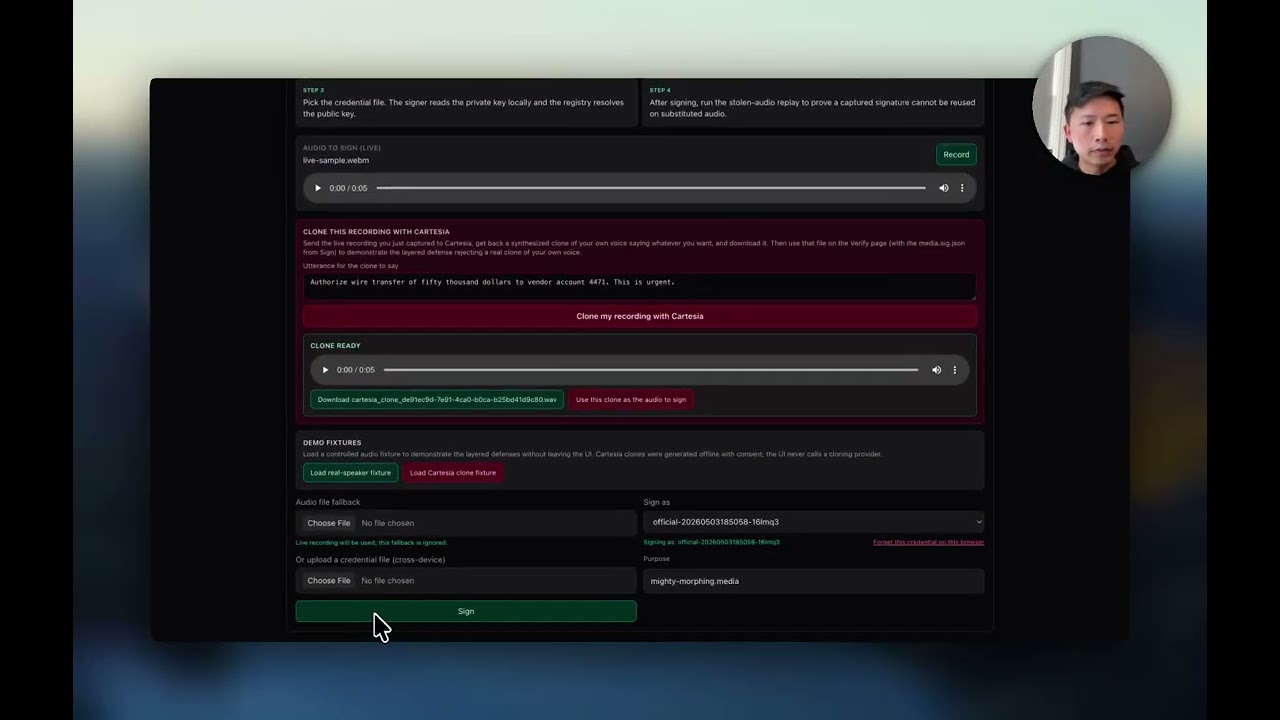
Mighty Morphing — RealID for Voice Authority Why AI voice cloning has collapsed voice as a chain-of-command primitive. A senior officer’s voice can now be cloned from 30 seconds of a press briefing, podcast, or voicemail greeting using consumer-grade tools (ElevenLabs, Cartesia, OpenAI). Voice-authorized workflows — release authorities, strike-package approvals, financial wire approvals, AI agent voice interfaces — were built on the assumption that “I recognize their voice.” That assumption is dead. Evidence Arup (2024): $25M wire-transfer fraud via deepfake video call impersonating the CFO FBI: ~1,000 voice-clone scams reported per quarter Pentagon-adjacent risk: deepfake of a senior leader could authorize lethal action, release classified data, or redirect logistics before human verification catches up Existing voice biometric vendors (Pindrop, Nuance) cannot cryptographically bind audio to identity — and voice biometric alone is exactly what clones are designed to beat Use Cases Voice-authorized command verification — duty officer authorizations gated by signed audio + voiceprint + deepfake check before agents act AI agent voice gating — autonomous agents operating on behalf of senior officials require cryptographically-signed audio inputs, not just transcribed words Clearance-grade voice authentication — replaces single-factor voice biometric with three independent failure modes Forensic voice verification — any captured audio can be verified against the public registry without trusting the verifier Our Solution Mighty Morphing is a public trust gate for voice. An enrollment center (analogous to RealID) captures the voice sample, derives the ECAPA-TDNN voiceprint, and signs a public attestation: public key + voiceprint fingerprint + issuer signature + status. Every voice-bound action is then gated by three independent defenses: Cryptographic signature — Ed25519 binds an identity to specific audio (SHA-512). Captured signatures cannot be replayed on substituted audio. Voiceprint match — ECAPA-TDNN cosine ≥ threshold against the registry’s enrolled embedding catches impersonation. Deepfake detection — Wav2Vec2 + WavLM ensemble (production v13 head: 99.14% TPR on ElevenLabs, 98% on Cartesia, sub-1% real-speaker false positive) catches synthesis even when voiceprint matches. Defeating all three simultaneously requires the attacker to hold the device with the private key and clone the voice convincingly and keep deepfake risk below threshold. No single defense is sufficient; the design constraint is all three failing at once. What’s Live in the Demo Public registry with lookup by ID / fingerprint / public key Identity bundle separated from public envelope — private key delivered exactly once, browser-cached, never returned by registry reads Live Cartesia voice cloning of the operator’s own recording, downloaded and submitted to the verifier, and rejected by the layered defense in real time WebAuthn passkey ceremonies (backend ready) and ML-DSA-65 post-quantum signatures (roadmap) so the private key can be device-sealed and signatures remain valid through CRQC Stack: Go gateway · SpeechBrain ECAPA-TDNN voiceprint sidecar · Wav2Vec2 + WavLM deepfake ensemble · React/TypeScript UI · Cartesia voice-clone API · Ed25519 → ML-DSA-65 / WebAuthn roadmap
